Why I built Solmex
From one more Excel sheet to a maintenance platform other teams can use.
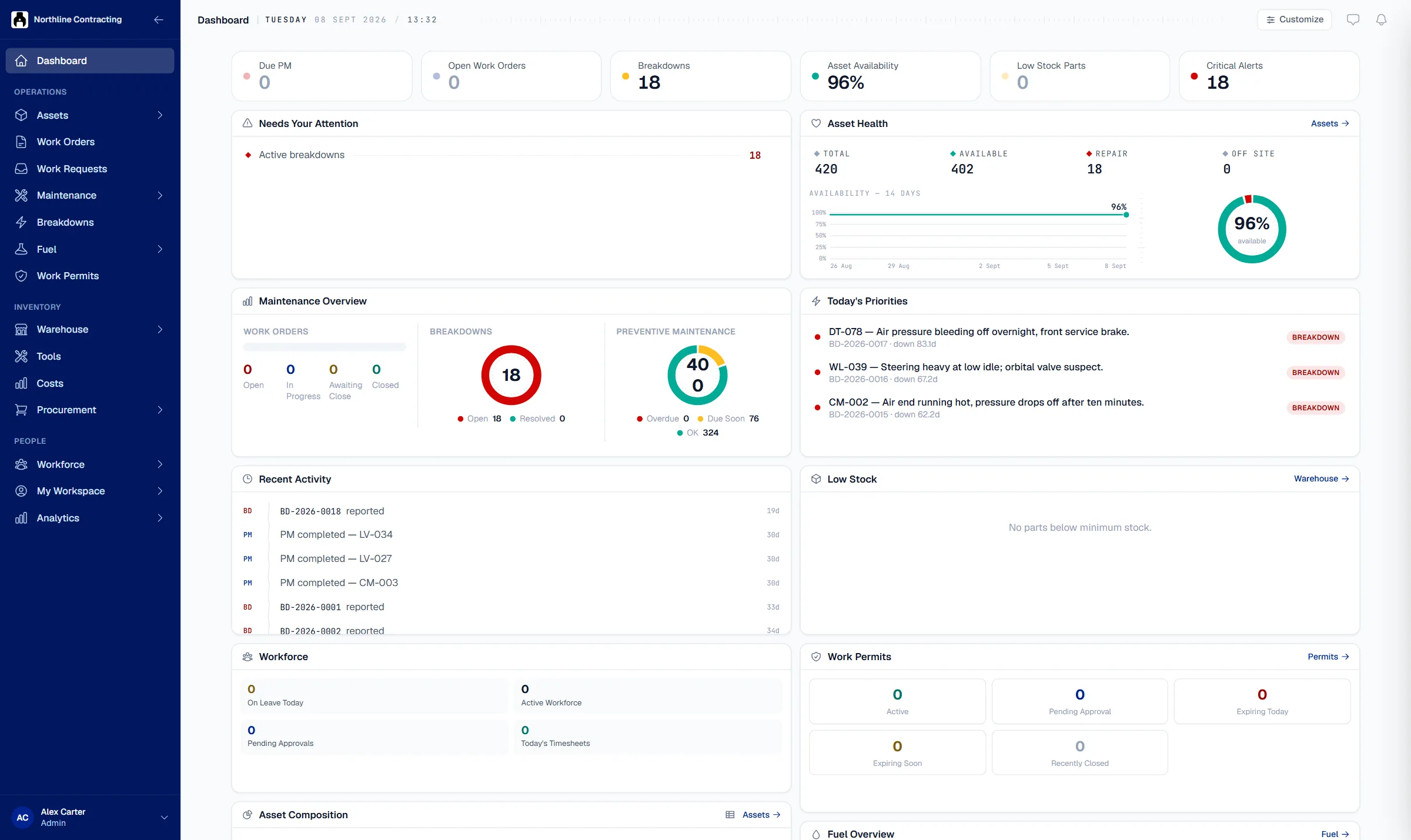
I was done with Excel
For years, maintenance on the sites I worked on ran on spreadsheets. On NEOM Trojena I built a whole Workshop Management System in Excel: assets, job cards, preventive maintenance, spare parts and the team. It worked, it passed audits, and it was even named the best maintenance digital infrastructure on the project. But I knew its limits better than anyone. Two people could not edit it at once, it could not hold a photo or a signature, and nobody could update it from the cab of a machine. Every morning started with merging, checking and fixing the file instead of fixing machines.
I just wanted my own work to be easier
Solmex did not start as a business idea. It started as a tool for me. I wanted one place where a meter reading, a breakdown, a work order and a spare part were connected, so I could stop copying the same fact into five different sheets.
At some point I realised I did not have to wait for someone else to build it. I could write it myself. So I did, in the evenings and at weekends, one module at a time: first the asset register and meter readings, then preventive maintenance, then work orders and breakdowns.
Then it became too good to keep to myself
As the app grew, I started using it on real work, and it kept answering questions that used to take me an hour in Excel: which machines are overdue for service, what a breakdown really cost, where a spare part went. That was when I realised it was not only my tool any more. Every maintenance team I have worked with fights the same spreadsheets. If it worked for me, it would work for them too. That is how Solmex became a product.
Designed from the user's side of the desk
Most maintenance software is designed by developers and then explained to technicians. Solmex is the other way round. I designed every screen the way I would want to use it myself on site: under pressure, with dirty hands and a phone in one of them.
A few examples. A supervisor can enter the morning meter readings for 200 machines on one screen and save once. An empty cell means "not read today", never zero. A fault reported from the QR code on a machine reaches the maintenance team in seconds. And a report fits on one page, because nobody reads page five.
Smart, connected and secure
Solmex does not want to be one more island. It connects to GPS trackers to show where each machine was last seen, imports your existing lists from Excel, exports every register back to Excel, and lets an administrator download all of the company's data whenever they want.
Security was not an afterthought. Each company's data is kept apart at the database level, every action has its own permission, and every change to a key record is written to an audit log. Being secure and being easy to use are not opposites. It just takes more care.
Where it is today
Solmex is live at getsolmex.com, in English and Turkish, with a free plan to start. So far it has been performing well: it was built and tested on a register of more than 500 machines, and the pages stay fast as the records grow.
I am still a maintenance engineer first. That is the reason Solmex exists, and the reason I keep improving it. If your team still runs maintenance on spreadsheets, I would love for you to try it.